

Patella Fracture Treatment in Louisville, KY
Expert Kneecap Fracture Treatment From a Fellowship-Trained Knee Orthopaedic Surgeon
A fractured kneecap is a painful and often sudden injury that can significantly disrupt your ability to walk, straighten your leg, or bear weight. The patella is the largest sesamoid (free-floating) bone in the body, and it plays a critical role in the function of the quadriceps muscle, transmitting the force needed for everyday movements like standing, climbing stairs, and rising from a seated position. When the patella fractures, restoring its integrity and alignment is essential to regaining full knee function.
Dr. Nyagon Duany is a fellowship-trained orthopedic surgeon in Louisville, KY, with dual training in sports medicine and total joint replacement. She is experienced in treating the full spectrum of patella and knee fractures, from stable, non-displaced fractures that can be managed conservatively to complex, comminuted injuries requiring surgery. Dr. Duany takes a thorough, individualized approach to fracture care, developing a treatment plan that prioritizes restoring your strength, function, and quality of life as efficiently and safely as possible.
If you have sustained a knee injury and are experiencing significant pain, swelling, or difficulty straightening your leg, use our online form to request an appointment with Dr. Duany today.
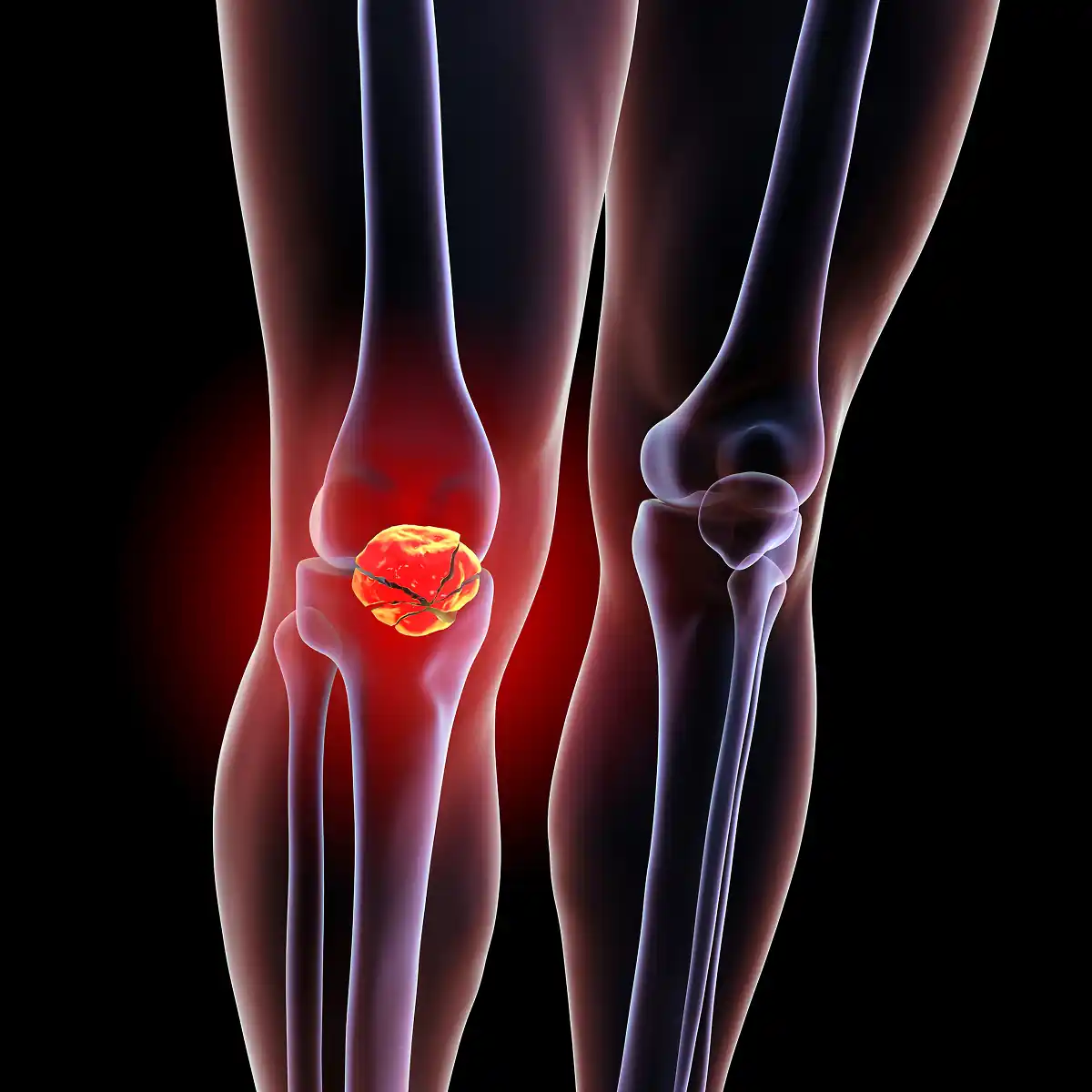
Patella Fracture Types, Symptoms & Treatment Options
Understanding Patella Fractures
The patella sits at the front of the knee within the quadriceps tendon, connecting the powerful thigh muscles to the shinbone (tibia) via the patellar tendon. This position makes it an important lever in knee extension. When fractured, the patella can disrupt the extensor mechanism entirely, making it difficult or impossible to straighten the leg under load. Prompt evaluation and appropriate treatment are critical to restoring this function and preventing long-term complications.
While there are multiple types of patella fractures, osteochondral fractures are most frequently sports-related. An osteochondral fracture involves a piece of cartilage and bone breaking away from the patella surface, most often as a result of a kneecap dislocation. These injuries can affect the joint surface and may require careful management to protect long-term cartilage health.
Patella Fracture Symptoms
Common patella fracture symptoms include:
- Sudden, severe pain at the front of the knee following an injury
- Significant swelling and bruising around the kneecap
- Tenderness directly over the patella
- Inability to straighten the leg or bear weight
- A visible deformity, gap, or irregularity at the front of the knee in displaced fractures
- Difficulty walking or climbing stairs
Patella Fracture Treatment Options
Treatment depends on the fracture type, the degree of displacement, and the integrity of the extensor mechanism.
For non-displaced or minimally displaced fractures in which the extensor mechanism is intact, conservative treatment is typically effective. This approach includes immobilization in a brace or immobilizer to protect the fracture while it heals, activity restriction during the early healing phase, and a progressive physical therapy program to restore range of motion and quadriceps strength once healing is confirmed on imaging.
For displaced fractures or fractures in which the extensor mechanism is compromised, surgical intervention is necessary to restore the alignment of the patella and repair the surrounding soft tissue structures. Dr. Duany performs open reduction and internal fixation (ORIF) of patella fractures, using hardware such as screws or tension band constructs to stabilize the bone fragments and allow controlled rehabilitation. For osteochondral fractures, arthroscopic evaluation may also be appropriate to assess and address any associated cartilage damage.
Frequently Asked Questions
What are the most common patella fracture symptoms?
The most common patella fracture symptoms include sudden, severe pain at the front of the knee, significant swelling and bruising, and difficulty or inability to straighten the leg. In displaced fractures, a visible gap or irregularity may be felt or seen over the kneecap. Many patients are also unable to bear weight on the affected leg. These symptoms warrant prompt evaluation; delaying treatment for a displaced fracture can compromise the extensor mechanism and make recovery significantly more difficult.
What are the different types of patella fractures, and how do they affect treatment?
The most common types of patella fractures are transverse, comminuted, vertical, and osteochondral, each varying in pattern, severity, and treatment implications. Transverse and comminuted fractures are the most likely to require surgery, particularly when the fragments are displaced or the extensor mechanism is disrupted. Vertical fractures are often more stable and may be managed conservatively. Osteochondral fractures require additional consideration for joint surface integrity. Dr. Duany will assess your fracture using imaging and a thorough physical examination to determine which approach is most appropriate for your specific injury.
Do I need surgery for a patella fracture?
Not all patella fractures require surgery. Non-displaced fractures with an intact extensor mechanism can often be treated successfully with immobilization, protected weight bearing, and a structured rehabilitation program. Surgery is typically recommended when the fracture fragments are significantly displaced, when the extensor mechanism is disrupted, or when the fracture pattern makes stable conservative management unlikely. Dr. Duany will review your imaging carefully and give you a clear, honest assessment of whether surgical or non-surgical treatment is the right path for your injury.
How do I find a knee orthopaedic surgeon near me in Louisville, KY?
If you are searching for a knee orthopaedic surgeon near you or a knee specialist in Louisville, KY, Dr. Duany makes it easy to get started. Simply fill out our online appointment request form or call us at (502) 629-5633, and our team will follow up to confirm your visit. Dr. Duany sees patients at two convenient Louisville locations and is committed to providing expert, personalized orthopaedic care to patients throughout the metro area and surrounding communities. We look forward to helping you recover and return to full function.