

Rotator Cuff Tear Treatment in Louisville, KY
Expert Rotator Cuff Tear Treatment From a Fellowship-Trained Shoulder Surgeon
The rotator cuff is one of the most important structures in the shoulder, and a tear can range from a minor nuisance to a life-altering injury. Whether your pain came on suddenly after a fall or has been building gradually over months of overhead activity, getting the right diagnosis and the right treatment plan makes all the difference in how fully and quickly you recover. Rotator cuff tears are among the most common shoulder injuries treated in orthopedic practice, but no two tears are identical; effective care depends on understanding the specific nature of your injury and your individual goals.
Dr. Nyagon Duany is a fellowship-trained orthopedic surgeon in Louisville, KY, with dual training in sports medicine and total joint replacement. She is an experienced rotator cuff tear specialist who treats the full spectrum of cuff injuries, from small partial-thickness tears managed conservatively to large, complex tears requiring surgical repair or reconstruction with graft augmentation. Dr. Duany performs minimally invasive arthroscopic rotator cuff repairs and takes a patient-first approach to every case, making sure you understand your options and feel confident in your treatment plan before moving forward.
If shoulder pain, weakness, or difficulty lifting your arm has been affecting your daily life, use our online form to request an appointment with Dr. Duany today.
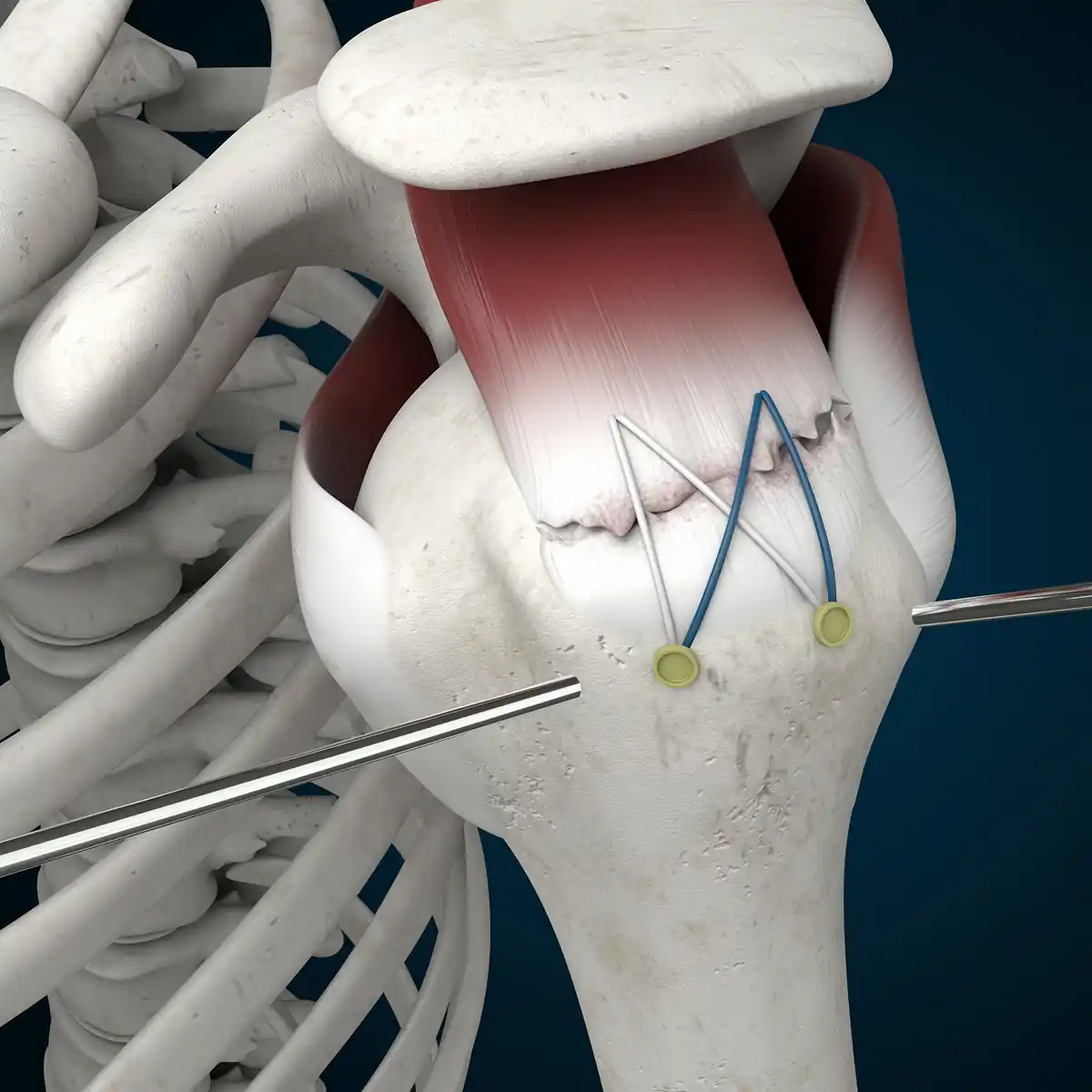
Rotator Cuff Tear Types, Symptoms & Treatment Options
Understanding Rotator Cuff Tears
The rotator cuff is made up of four muscles and their tendons — the supraspinatus, infraspinatus, teres minor, and subscapularis — that work together to stabilize the shoulder joint and power arm movement. A tear in any one or more of these tendons disrupts that balance, causing pain, weakness, and reduced range of motion. Left untreated, rotator cuff tears can grow larger over time and, in severe cases, progress to rotator cuff arthropathy.
Types of Rotator Cuff Tears
Rotator cuff tears are classified in two key ways: by depth and by cause.
By depth:
- Partial-thickness tears involve damage to part of the tendon without a complete separation; these are often managed conservatively, though larger partial tears may require surgery
- Full-thickness tears involve a complete rupture of the tendon from its attachment; these are more likely to require surgical repair, particularly in active patients
By cause:
- Acute tears result from a sudden injury such as a fall on an outstretched arm, a direct blow to the shoulder, or a forceful lifting or pulling movement
- Degenerative tears develop gradually over time due to repetitive stress, reduced blood supply to the tendon, and age-related tendon weakening; these are the most common type and are frequently seen in patients over 40
Rotator Cuff Tear Symptoms
Common rotator cuff tear symptoms include:
- A dull ache deep in the shoulder, often worse at night
- Pain that intensifies with overhead activity, reaching behind the back, or lifting
- Weakness in the shoulder and arm, particularly when lifting or rotating
- A crackling or grinding sensation during shoulder movement
- Difficulty with everyday tasks such as combing hair, reaching overhead, or carrying objects
- In acute tears, sudden sharp pain and immediate weakness at the time of injury
Because these symptoms can overlap with other shoulder conditions such as shoulder bursitis and tendinitis and biceps tendinitis, an accurate diagnosis from an experienced rotator cuff surgeon is essential before beginning treatment.
Rotator Cuff Tear Treatment Options
Treatment is determined by the size and type of the tear, the patient's age and activity level, and how long the injury has been present.
Conservative treatment is appropriate for many partial tears and may include:
- Anti-inflammatory medications to manage rotator cuff tear pain and swelling
- Corticosteroid injections for targeted relief that supports participation in physical therapy
- Physical therapy to strengthen the muscles surrounding the shoulder, improve mechanics, and compensate for the damaged tendon
- Activity modification to reduce ongoing stress on the injured tissue
- Platelet-rich plasma (PRP) therapy as a supportive orthobiologic option to promote tendon healing and reduce inflammation
Surgical treatment is recommended when conservative care has not provided adequate relief, when the tear is large or complete, when there is significant weakness compromising daily function, or when an acute tear occurs in an otherwise healthy, active patient. Dr. Duany performs arthroscopic rotator cuff repair, which allows her to reattach the torn tendon to the bone through small incisions. Key advantages of the arthroscopic approach include:
- Minimal disruption to surrounding tissue
- Reduced post-operative pain compared to open surgery
- Lower risk of infection and complication
- A more efficient recovery with a faster return to activity
For patients with a medium- to large rotator cuff tear involving significant tendon loss or retraction, a graft augmentation procedure using the Zuri patch may be considered to reinforce the repair and improve outcomes, sometimes decreasing the sling wear. The patch adds mechanical strength on day one. Dr. Duany will evaluate the extent of your tear and determine whether augmentation is appropriate for your case.

Advanced Rotator Cuff Repair Technology
ZuriMED Graft Augmentation
For patients with large or complex rotator cuff tears, the strength and integrity of the repair can be the difference between a full recovery and a re-tear. Dr. Nya Duany uses ZuriMED graft augmentation to reinforce rotator cuff repairs, adding a biological scaffold that supports healing and reduces the risk of failure in challenging cases. ZuriMED's collagen-based graft integrates with the body's own tissue over time, providing both immediate mechanical support and a framework for long-term tendon regeneration — giving patients the best possible foundation for a durable, lasting repair.
Frequently Asked Questions
What are the most common rotator cuff tear symptoms?
The most common rotator cuff tear symptoms include:
- A persistent deep ache in the shoulder, particularly at night
- Pain with overhead reaching, lifting, or rotating the arm
- Shoulder and arm weakness, especially when lifting against resistance
- A crackling or grinding sensation during movement
- Difficulty with everyday tasks like combing hair or reaching into a cabinet
Symptoms can develop suddenly after a traumatic injury or gradually over time. If your shoulder pain and weakness have persisted for more than a few weeks, an evaluation with an experienced rotator cuff tear specialist is strongly recommended.
Do I need surgery for a rotator cuff tear?
Whether surgery is necessary depends on several factors, including the size and type of the tear, your age, activity level, and how well your symptoms respond to conservative care. Many partial tears can be managed successfully without surgery, particularly in older or less active patients. Surgery is more likely to be recommended for:
- Complete, full-thickness tears
- Acute tears in young or active patients
- Tears causing significant weakness that limits daily function
- Partial tears that have not improved after several months of conservative care
Dr. Duany will review your MRI, assess your clinical picture, and give you a clear, honest recommendation tailored to your specific situation.
What is rotator cuff surgery, and what does recovery look like?
Rotator cuff surgery typically involves arthroscopic repair, in which the torn tendon is reattached to the bone through small incisions. The procedure is performed on an outpatient basis in most cases. Recovery involves:
- A period of immobilization in a sling to protect the repair
- Progressive physical therapy beginning within a few weeks to restore motion and strength
- Return to light daily activities within a few months
- Full recovery and return to sport or heavy activity typically taking four to six months or longer, depending on the size of the tear
Dr. Duany and her team will guide you through every phase of recovery, monitoring your healing closely and adjusting your rehabilitation plan as needed.
How do I find a rotator cuff surgeon near me in Louisville, KY?
If you are searching for a rotator cuff surgeon near you or an orthopedic doctor in Louisville, KY, Dr. Duany makes it easy to get started. Simply fill out our online appointment request form or give us a call at (502) 629-5633, and our team will follow up to confirm your visit. Dr. Duany sees patients at two convenient Louisville locations and is committed to providing expert, personalized shoulder care to patients throughout the metro area and surrounding communities. We look forward to helping you recover and return to full strength.